
From Avoidance to Removal: Why the Voluntary Carbon Market Is Finally Growing Up in 2026
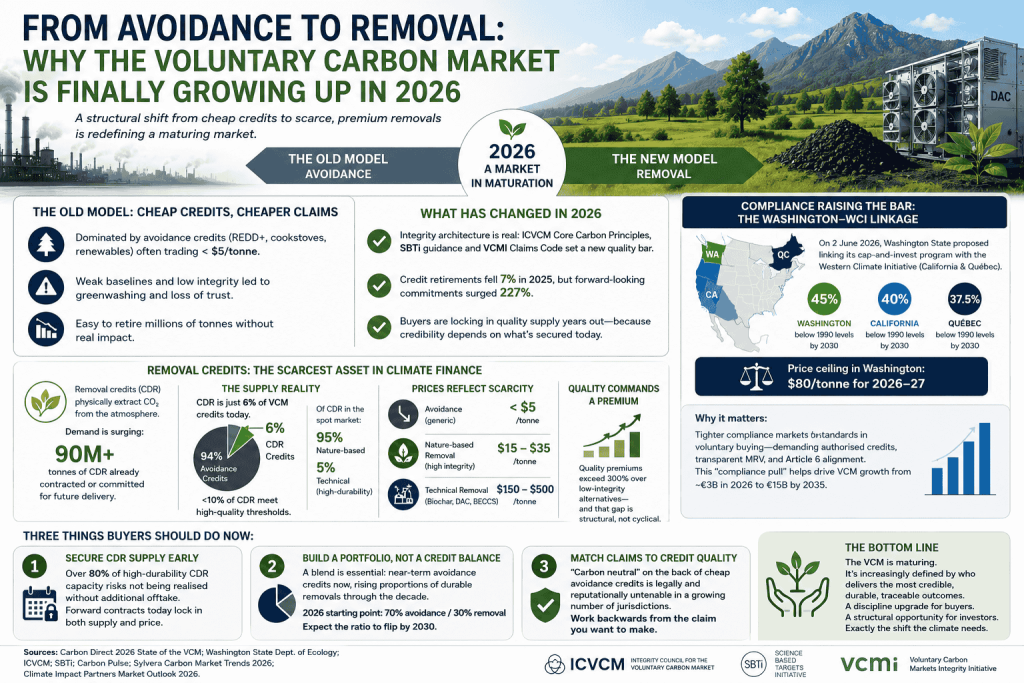
The voluntary carbon market has had a rough year. Scandals over phantom forest credits, greenwashing accusations, and a flood of cheap offsets nearly destroyed its credibility between 2022 and 2024. Yet in 2026, something has shifted. The market is not collapsing it is maturing. And the clearest signal of that maturity is a structural move away from cheap avoidance credits toward scarce, premium removal credits.
The old model: cheap credits, cheaper claims
For most of its history, the VCM was dominated by avoidance credits a tonne of CO₂ theoretically prevented from being emitted, usually through protecting forests, funding cookstoves, or backing renewables in developing economies. Often trading below $5 per tonne, these credits were easy to retire by the millions, letting companies claim carbon neutrality without fundamentally changing operations.
The logic was appealing. The execution was frequently flawed. Studies showed many REDD+ projects had vastly overstated their baselines crediting emissions that were never truly at risk. Corporate net-zero claims built on these credits crumbled under scrutiny. The market lost trust. That reckoning, it turns out, was productive.
What has changed in 2026
The integrity architecture is now real. The ICVCM’s Core Carbon Principles set a quality baseline every project must meet to carry an integrity label. SBTi has formalised the role of high-quality credits within net-zero pathways. The VCMI Claims Code standardised what companies can actually say about their purchases.
The numbers reflect this shift. Credit retirements fell 7% in 2025 but forward-looking commitments surged 227%. Buyers are no longer shopping spot. They are locking in supply years out, because they know that what they can credibly claim tomorrow depends on the quality of what they secure today.
Removal credits: the scarcest asset in climate finance
Carbon Dioxide Removal (CDR) credits from afforestation and soil carbon to biochar, BECCS, and direct air capture physically extract CO₂ from the atmosphere. Demand is surging: over 90 million tonnes of CDR is already contracted or committed for future delivery. Analysts forecast removal credits growing at a 56% CAGR one of the fastest-growing asset classes in climate finance.
The supply reality is sobering. CDR is just 6% of VCM credits today, and fewer than 10% of those meet high-quality thresholds. Of CDR in the spot market, 95% is nature-based; only 5% comes from high-durability technical approaches.
Prices reflect this scarcity. Generic avoidance credits still trade below $5/tonne. High-integrity nature-based removal credits fetch $15–$35/tonne. Biochar and DAC command $150–$500/tonne and buyers are still paying, because securing supply now is also securing strategic optionality later. Quality premiums have exceeded 300% over low-integrity alternatives, and that gap is structural, not cyclical.
The Washington–WCI linkage: compliance raising the bar
The VCM does not mature in isolation. This week’s most significant market development came on 2 June 2026, when Washington State’s Department of Ecology submitted a formal regulatory proposal to link its cap-and-invest programme with the Western Climate Initiative the combined carbon market of California and Québec. A draft linkage agreement had already gone to public review in March.
If finalised, the linked market could launch as early as 2027 creating the largest carbon trading bloc in the Americas. Washington targets a 45% cut in emissions below 1990 levels by 2030; California 40%; Québec 37.5%. Washington’s price ceiling sits at $80/tonne for 2026–27.
Why does this matter for voluntary buyers? Because compliance-grade scrutiny bleeds into voluntary markets. When regulated entities face tighter caps and higher prices, they apply the same rigour to voluntary purchases demanding authorised credits, transparent MRV, and Article 6 alignment. This “compliance pull” is one reason the VCM overall is forecast to grow from ~€3 billion in 2026 to €15 billion by 2035.
Three things’ buyers should do now:
1. Secure CDR supply early. Over 80% of high-durability CDR capacity risks not being realised without additional offtake. Forward contracts today lock in both supply and price before the market tightens further.
2. Build a portfolio, not a credit balance. The Oxford Principles and VCMI both recommend a blend: near-term avoidance credits now, rising proportions of durable removals through the decade. A rough 2026 starting point: 70% avoidance, 30% removal with the expectation of that ratio flipping by 2030.
3. Match claims to credit quality. “Carbon neutral” on the back of cheap avoidance credits is legally and reputationally untenable in a growing number of jurisdictions. Work backwards from the claim you want to make.
The bottom line
The VCM is not yet what the climate needs it to be 157 million tonnes retired in 2025 is far below the billion-tonne ambitions of a few years ago. But the direction of travel has changed. The market is no longer defined by who sells the most tonnes at the lowest price. It is increasingly defined by who delivers the most credible, durable, traceable outcomes.
For buyers, this is a discipline upgrade. For investors, a structural opportunity. For the climate, exactly the shift that was needed.
Sources: Carbon Direct 2026 State of the VCM; Washington State Dept. of Ecology; ICVCM; SBTi; Carbon Pulse; Sylvera Carbon Market Trends 2026; Climate Impact Partners Market Outlook 2026.