
PLUG IN OR FALL BEHIND: WHY INDIA’S MANUFACTURERS ARE SIGNING SOLAR PPAS TO STAY COMPETITIVE
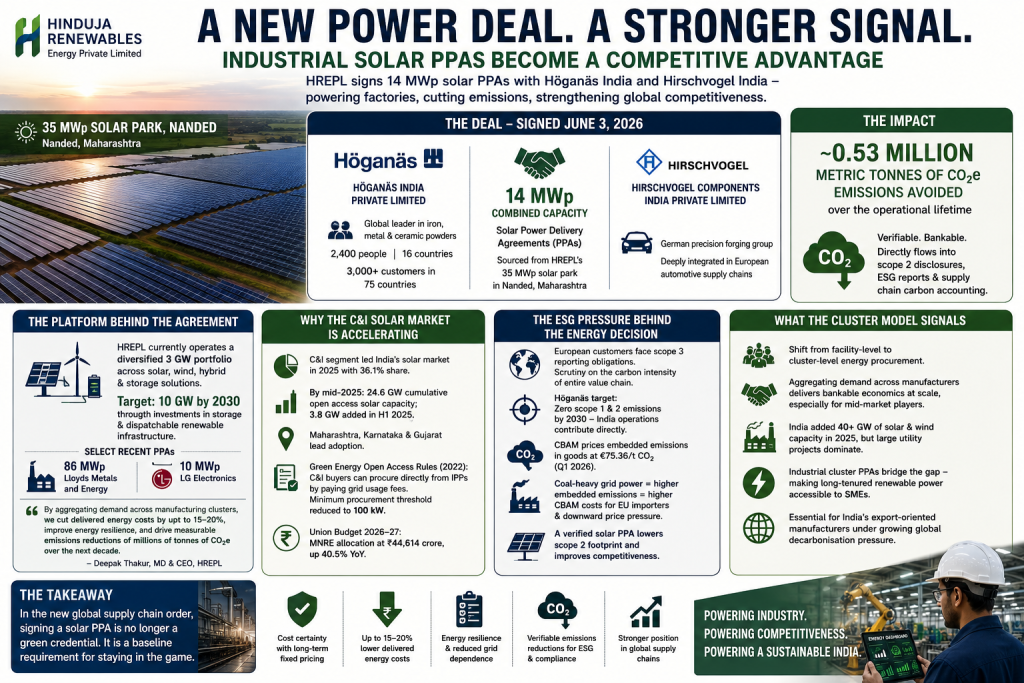
A quiet but consequential shift is underway on India’s factory floors. The energy contract once a purely operational decision made by a procurement team has become a sustainability instrument, a cost hedge, and increasingly, a signal to global buyers about a company’s carbon seriousness. The deal announced on June 3, 2026 between Hinduja Renewables Energy Private Limited (HREPL) and two European manufacturing majors captures this shift precisely.
The Deal and What It Represents
HREPL has signed solar Power Delivery Agreements with Höganäs India Private Limited and Hirschvogel Components India Private Limited, with the two PPAs carrying a combined capacity of 14 MWp, sourced from HREPL’s 35 MWp solar park in Nanded, Maharashtra. On the surface, 14 MW is a modest number. But the identity of the offtakers matters as much as the megawatts. Höganäs is a global leader in iron, metal, and ceramic powder manufacturing, employing 2,400 people across 16 countries and serving over 3,000 customers in 75 countries a company whose customers include automotive and electric vehicle component manufacturers with their own carbon accounting obligations. Hirschvogel is a German precision forging group with deep integration into European automotive supply chains. Both are precisely the kind of industrial anchor tenants whose energy decisions cascade upstream and downstream.
The projects are expected to avoid approximately 0.53 million metric tonnes of CO₂ equivalent emissions over their operational lifetime. That is not an incidental figure. It is a verifiable, bankable emissions reduction that can flow directly into scope 2 disclosures, ESG reports, and increasingly, supply chain carbon accounting requested by EU customers.
The Platform Behind the Agreement
This transaction sits within a much larger strategic build. HREPL currently operates a diversified 3 GW portfolio across solar, wind, hybrid, and storage solutions, and is executing a roadmap to expand this to 10 GW by 2030 through targeted investments in storage and dispatchable renewable infrastructure. The Nanded park is one node in that platform, and the cluster-based approach aggregating industrial demand across manufacturing zones rather than serving individual facilities is where the model becomes economically compelling.
Deepak Thakur, MD and CEO of HREPL, has stated that by aggregating demand across manufacturing clusters, the company can cut delivered energy costs by up to 15 to 20%, improve energy resilience, and drive measurable emissions reductions in the order of millions of tonnes of CO₂e over the next decade. The cost reduction figure is significant: grid-connected industrial electricity in Maharashtra carries tariff uncertainty and cross-subsidy burdens that PPAs with long-term fixed pricing directly eliminate. HREPL has previously signed an 86 MWp agreement with Lloyds Metals and Energy and a 10 MWp agreement with LG Electronics, indicating the platform is attracting both heavy industry and consumer electronics manufacturers sectors with very different production profiles but the same underlying need for reliable, low-carbon, cost-predictable power.
Why the C&I Solar Market Is Accelerating
This deal is part of a broader structural trend in India’s industrial energy market. The commercial and industrial segment led India’s solar market with a 36.1% share in 2025, heavily driven by corporate sustainability commitments, favourable net metering policies, and the urgent need to hedge against escalating grid electricity costs. By mid-2025, cumulative open access solar capacity stood at around 24.6 GW, with 3.8 GW added in the first half of the year alone, with Maharashtra, Karnataka, and Gujarat emerging as leaders in adoption.
The policy architecture is also maturing. India’s Green Energy Open Access Rules, introduced in 2022, allow C&I buyers to procure directly from independent power producers by paying grid usage fees, and the minimum procurement threshold has been reduced to 100 kW a change that has opened the market to mid-sized manufacturers who previously could not participate. The Union Budget 2026-27 further reinforced this direction, with the Ministry of New and Renewable Energy allocation reaching Rs. 44,614 crore, a 40.5% increase over the previous year’s estimates.
The ESG Pressure Behind the Energy Decision
What makes industrial PPAs structurally different from earlier corporate solar adoption is the regulatory pressure now embedded in global supply chains. European manufacturers like Höganäs and Hirschvogel operate under scope 3 emissions reporting obligations and face scrutiny from customers, investors, and regulators on the carbon intensity of their entire value chain, including their Indian subsidiaries and suppliers. Höganäs has committed to a carbon intensity index target of zero scope 1 and 2 emissions by 2030, which makes its India operations a direct contributor to or detractor from that global target. Sourcing power from a verified solar PPA is one of the most straightforward mechanisms to reduce the scope 2 footprint of a manufacturing facility.
The CBAM dimension adds further urgency. As the EU’s carbon border levy prices embedded emissions in manufactured goods at €75.36 per tonne of CO₂ for Q1 2026, the carbon intensity of electricity used in Indian production facilities becomes a commercial variable, not just a sustainability metric. Manufacturers running on coal-heavy grid power face structurally higher embedded emissions, which translate directly into higher CBAM costs for their EU importers and downward price pressure on contracts. A solar PPA with verified generation data changes that calculus.
What the Cluster Model Signals
The most important strategic signal in the HREPL model is the shift from facility-level to cluster-level energy procurement. By aggregating demand across multiple manufacturers in a region, as the Nanded park does for the Marathwada industrial belt, developers can achieve bankable project economics at scales that individual SMEs could never reach alone. India added more than 40 GW of solar and wind capacity in 2025, but the distribution of that capacity still skews toward large utility projects. The industrial cluster PPA model bridges that gap, making long-tenured renewable supply accessible to mid-market manufacturers who form the backbone of India’s export economy, and who are under growing pressure from global buyers to demonstrate credible decarbonisation pathways.
The Hinduja-Höganäs-Hirschvogel agreement is a single data point. But it points toward a market structure where signing a solar PPA is no longer a green credential. It is a baseline requirement for staying in the supply chain.
References
- EPC World. (2026, June 3). HREPL accelerates industrial decarbonisation with 14 MWp solar power agreements. https://www.epcworld.in/hrepl-accelerates-industrial-decarbonisation-with-14-mwp-solar-power-agreements/
- Expert Market Research. (2026, January 27). Top 6 metal powder companies in the world. https://www.expertmarketresearch.com/blogs/top-metal-powder-companies
- Höganäs AB. (n.d.). Sustainability. https://www.hoganas.com/en/sustainability/
- IBEF. (2026). India’s renewable energy growth: Solar power and more. https://www.ibef.org/industry/renewable-energy
- Inkwood Research. (2025). India solar energy market size and analysis: 2025–2032. https://www.inkwoodresearch.com/reports/india-solar-energy-market/
- MediaBrief. (2026, June 5). Hinduja Renewables signs 14 MWp solar power delivery pacts with Höganäs and Hirschvogel. https://mediabrief.com/hinduja-renewables-signs-14-mwp-solar-power-delivery-pacts-with-hoganas-and-hirschvogel/
- Passionate in Marketing. (2026, June 3). Hinduja Renewables advances industrial decarbonisation with new solar power agreements. https://www.passionateinmarketing.com/hinduja-renewables-advances-industrial-decarbonisation-with-new-solar-power-agreements/
- Power Line Magazine. (2026, June 3). Hinduja Renewables signs agreements with industrial consumers for solar power supply. https://powerline.net.in/2026/06/03/hinduja-renewables-signs-agreements-with-industrial-consumers-for-solar-power-supply/
- PV Magazine India. (2026, March 13). Open access solar set to drive next phase of India’s C&I growth. https://www.pv-magazine.com/2026/03/13/open-access-solar-set-to-drive-next-phase-of-indias-ci-growth/
- PV Magazine. (2026, January 5). India’s 2025 renewable energy sector review: Capacity growth and constraints. https://www.pv-magazine.com/2026/01/05/indias-2025-renewable-energy-sector-review-capacity-growth-and-constraints/
- Eurometal. (2026, April 8). European Commission provides critical CBAM cost component. https://eurometal.net/european-commission-provides-critical-cbam-cost-component/