
Urban Water Supply Disruption Highlights Critical Groundwater Management Challenges in Mumbai
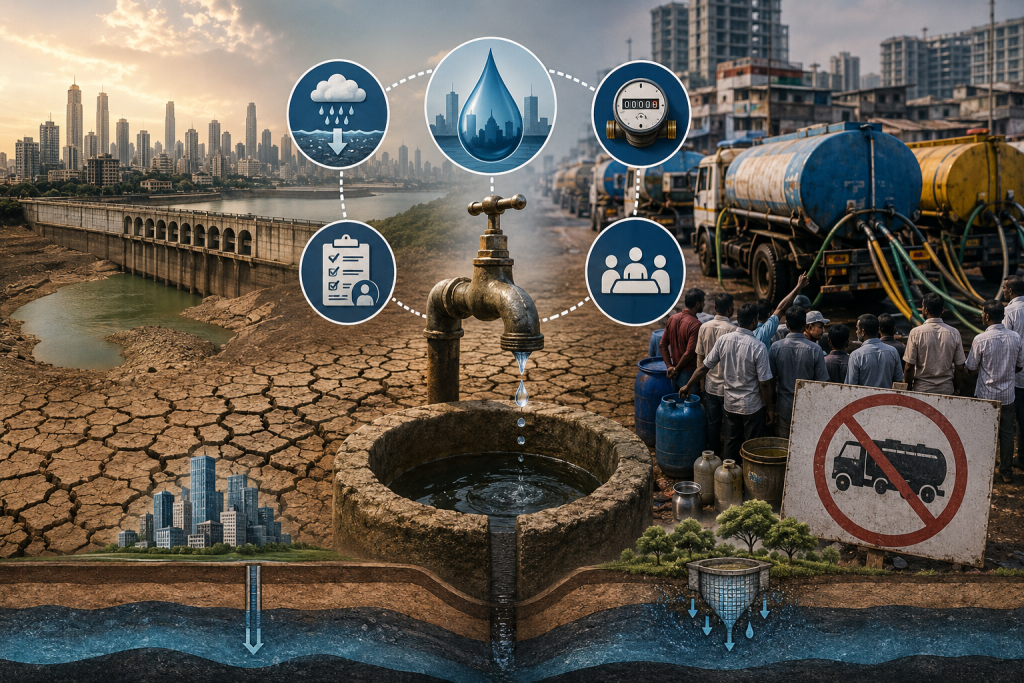
On June 7, 2026, Mumbai woke up to the prospect of its taps running completely dry. The Mumbai Water Tanker Association had called an indefinite strike beginning midnight, protesting what it described as the harsh and selective enforcement of Central Ground Water Authority norms. The timing could not have been worse. The BMC had already imposed a 10% water cut across the city from May 15, reservoir levels were critically low, and the southwest monsoon was still days away. The strike lasted only a short while before the BMC invoked the Disaster Management Act to requisition private tankers and wells, forcing a withdrawal. But the crisis it revealed — the structural dependence of a city of 20 million people on an informal, unregulated groundwater economy — will not resolve itself once the monsoon arrives.
The Numbers Behind the Crisis
The immediate trigger was regulatory. The CGWA’s revised norms, implemented through the Bhu-Neer portal, required tanker operators to demonstrate ownership or lease of a 200-square-metre plot, install digital water flow meters, maintain daily extraction logs, comply with BIS standards, and obtain a no-objection certificate. The tanker industry, which has served Mumbai for over 80 years, argued that these requirements were next to impossible for small operators to meet within the given timeline and that the norms were being applied exclusively within the Mumbai Division.
Beneath the procedural dispute lies a supply crisis of serious proportions. By May 23, 2026, Mumbai’s seven lakes held just 19.22% of their combined storage capacity — equivalent to 2,78,199 million litres against a total capacity of 14,47,363 million litres. The BMC, which typically supplies between 3,950 and 4,100 million litres per day, had reduced daily supply to approximately 3,600 to 3,750 million litres following the imposed cut. The civic body was simultaneously seeking an additional 237 million cubic metres from the Vaitarna and Bhatsa reservoirs through the Urban Development Department, aiming to extend existing stocks until August 17. The Mumbai Water Tanker Association operates approximately 1,800 registered tankers supplying around 350 million litres per day to parts of the city — a volume that represents nearly 10% of total daily demand. For newly developed localities where the BMC’s piped network remains inadequate, that number is the entire supply.
Groundwater as an Urban Crutch
The deeper problem is structural. India is the world’s single largest user of groundwater, drawing approximately 25% of all groundwater extracted globally. Nationally, groundwater irrigates 62% of agricultural land, supplies 85% of rural drinking water, and meets nearly half of all urban water requirements. The Central Ground Water Board’s 2025 compilation classifies 26% of India’s 6,700-plus assessment units as overexploited, critical, or semi-critical — meaning extraction already exceeds or approaches the rate of recharge. In 2025 alone, 730 assessment units, or 10.8% of the national total, were categorised as over-exploited.
Urban centres are accelerating this problem. A 2025 study published in Nature Sustainability examined groundwater depletion across Delhi, Mumbai, Kolkata, Bengaluru, and Chennai and found a direct link between land subsidence and groundwater over-extraction, with the trend affecting over 13 million buildings and nearly 80 million residents across these five cities. Research on Mumbai specifically has documented negative correlations between urban expansion and groundwater levels, with the expansion of impervious surfaces — roads, buildings, concrete — directly restricting aquifer recharge. A 2025 study further found that groundwater depth in Mumbai is rising due to over-extraction during non-monsoon seasons: the period when the tanker economy is most active and demand is highest.
The Regulatory Collision
The CGWA norms at the centre of the tanker dispute are not arbitrary — they are a response to precisely this documented depletion trend. The CGWA, established under the Environment (Protection) Act 1986, is mandated to regulate groundwater extraction in notified areas, and Mumbai’s aquifers fall within its jurisdiction. Digital meters, extraction reporting, and NOC requirements are the tools of managed aquifer governance. The problem is not the intent of the regulation but the implementation gap: requirements designed for large, formalised extraction operations being applied overnight to an industry of small, often informal operators who have had no transition support, no simplified compliance pathway, and no grace period.
The invocation of the Disaster Management Act to override the strike and the subsequent stay on well and borewell notices until June 15, following directives from Chief Minister Devendra Fadnavis and Union Minister of Jal Shakti CR Paatil, resolved the immediate crisis. But it also set a precedent: that regulatory enforcement on groundwater extraction is politically negotiable when supply comes under pressure. That precedent is exactly what the CGWA norms were designed to prevent.
What the Crisis Demands
Three structural interventions stand out. First, the CGWA compliance pathway for the tanker industry needs to be redesigned for operational reality — phased timelines, simplified portal access, and compliance assistance for operators below a threshold capacity. The direction given to simplify the Bhu-Neer portal during the crisis-period meeting at Bandra Kurla Complex was a start, not a solution. Second, Mumbai needs an accelerated managed aquifer recharge programme. Cities including Pune and Ahmedabad have begun integrating recharge wells and percolation pits into urban infrastructure planning; Mumbai has the institutional capacity to do the same at scale. Third, the tanker economy needs to be brought formally within the city’s water governance framework, with extraction data flowing into the same BMC water accounting system that monitors reservoir levels and daily demand. At present, 350 million litres per day of informal supply is essentially invisible to the city’s planners.
Mumbai’s water crisis is not a monsoon problem. It is a governance problem that the monsoon temporarily conceals each year. The events of June 2026 have removed that concealment, at least for now. Whether the policy response matches the structural scale of the challenge will determine whether this becomes an annual crisis or a turning point.
References
- Dalvoy / UPSC. (2025, December 6). Groundwater depletion in India: Causes and government mitigation steps. https://www.dalvoy.com/en/upsc/mains/previous-years/2025/general-studies-paper-iii/groundwater-depletion-india-causes-government-mitigation-steps
- Deccan Herald. (2025, April 14). Mumbai water tanker operators call off indefinite strike. https://www.deccanherald.com/india/maharashtra/mumbai-water-tanker-operators-call-off-indefinite-strike-3493227
- Deccan Herald. (2025, April 13). As water tanker strike continues, BMC invokes Disaster Management Act to gain upper hand. https://www.deccanherald.com/amp/story/india/maharashtra/as-water-tanker-strike-continues-bmc-invokes-disaster-management-act-to-gain-upper-hand-3492147
- Free Press Journal. (2026, May 23). Mumbai’s seven lakes at 19.22% capacity despite 10% water cut; BMC seeks additional water stock to last till August. https://www.freepressjournal.in/mumbai/mumbais-seven-lakes-at-1922-capacity-despite-10-water-cut-bmc-seeks-additional-water-stock-to-last-till-august
- Free Press Journal. (2026, June 6). Mumbai water crisis looms: Tanker Association calls indefinite strike from June 7 amid CGWA norm dispute. https://www.freepressjournal.in/mumbai/mumbai-water-crisis-looms-tanker-association-calls-indefinite-strike-from-june-7-amid-cgwa-norm-dispute
- Free Press Journal. (2026, June 6). Mumbai water crisis looms: Tanker operators announce indefinite shutdown from June 7 over CGWA norms. https://www.freepressjournal.in/mumbai/mumbai-water-crisis-looms-tanker-operators-announce-indefinite-shutdown-from-june-7-over-cgwa-norms
- NewsX. (2026, May 11). Will Mumbai face 10% water cut from May 15? BMC warns of supply restrictions as lake levels drop. https://www.newsx.com/regionals/will-mumbai-face-10-water-cut-from-may-15-bmc-warns-of-supply-restrictions-as-lake-levels-drop-217302/
- ORF Online. (2026, March 26). Arresting India’s groundwater depletion to avert water bankruptcy. https://www.orfonline.org/expert-speak/arresting-india-s-groundwater-depletion-to-avert-water-bankruptcy
- PMC / National Institutes of Health. (2025). Groundwater depletion in India: The influence of seasonal precipitation and land use land cover. https://pmc.ncbi.nlm.nih.gov/articles/PMC12804263/
- Republic World. (2026, May). Water woes ahead: BMC cuts Mumbai water supply by 10% amid weak monsoon fears as lakes run low. https://www.republicworld.com/india/water-woes-ahead-bmc-cuts-mumbai-water-supply-by-10-amid-weak-monsoon-fears-as-lakes-run-low
- World Bank IEG. (2021, August 23). Addressing groundwater depletion: Lessons from India, the world’s largest user of groundwater. https://ieg.worldbankgroup.org/blog/addressing-groundwater-depletion-lessons-india-worlds-largest-user-groundwater
- Zee Biz. (2026, June). Mumbai water crisis: Tanker strike hits Mumbai hard; BMC invokes emergency powers to restore water supply. https://www.zeebiz.com/trending/news-mumbai-water-crisis-tanker-strike-hits-mumbai-hard-bmc-emergency-action-water-tanker-regulation-disaster-management-355226