
From Assembly Line to Energy Leader: What Maruti Suzuki’s Rs. 925 Crore Green Investment Signals for India’s Auto Sector
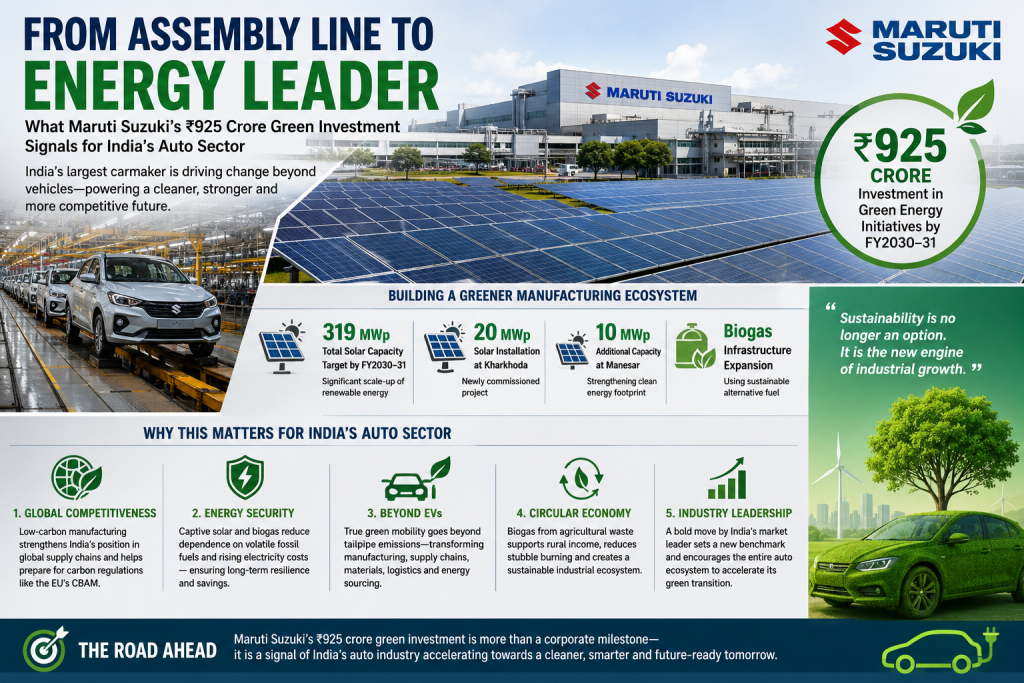
India’s largest automaker has placed a significant bet on clean energy, and the architecture of that bet tells a more interesting story than the headline number alone. On World Environment Day 2026, Maruti Suzuki India announced a commitment of Rs. 925 crore toward green energy initiatives by FY 2030-31, spanning solar expansion, biogas infrastructure, and a shift to green grid power. The announcement marks one of the most comprehensive facility-level decarbonisation programmes disclosed by an Indian manufacturer to date, and it arrives at a moment when the pressure to clean up how vehicles are made is intensifying from multiple directions.
The Investment Architecture
The Rs. 925 crore commitment is structured across three interlocking tracks. The largest allocation targets solar capacity, with a goal of reaching 319 MWp in renewable solar power by FY 2030-31. Over the past year alone, the company added 30 MWp through two new installations a 20 MWp array at its upcoming Kharkhoda facility in Haryana and a 10 MWp unit at the Manesar plant bringing cumulative installed solar capacity from 49 MWp to 79 MWp. By FY 2030-31, the company expects renewable sources to account for nearly 85% of its total electricity consumption, a substantial shift from the 15.6% share recorded as recently as FY 2024.
The second track is biogas. Maruti Suzuki has announced two dedicated projects with a combined investment of Rs. 150 crore. The first and larger of the two is a new 10 tonnes per day biogas plant at the Kharkhoda facility, scheduled for commissioning within FY 2026-27. At full capacity, the plant is expected to mitigate 9,490 tonnes of CO2 annually and meet approximately 20% of the facility’s total gas requirement through anaerobic digestion of organic waste streams. The second project expands the existing biogas plant at the Manesar facility from 0.2 TPD to 0.7 TPD, deepening the company’s decentralised gas supply. Both projects are aligned with the government’s Waste-to-Wealth mission, converting manufacturing waste into a direct energy input.
The third track is green grid procurement. The company is increasing the share of green power sourced from state electricity boards, complementing its captive solar base and reducing dependence on coal-heavy conventional grid supply. At its Hansalpur facility in Gujarat, biogas has already replaced natural gas for approximately 10% of energy requirements — a transition credited with maintaining operational continuity during periods of LNG supply disruption, and supported by SRDI, a wholly owned subsidiary of Suzuki Motor Corporation Japan.
The Sector Context
The timing of this commitment is not incidental. India’s automotive sector is at an inflection point on manufacturing emissions, and clean energy at the factory level is increasingly central to that conversation. A July 2025 study by the Council on Energy, Environment and Water found that India’s automobile industry could reduce its manufacturing emissions by up to 87% by 2050 through a shift to 100% renewable electricity, adoption of hydrogen-based and scrap-intensive steelmaking, and low-carbon procurement standards across supply chains. The same study found that Scope 3 emissions — primarily from coal-intensive steel and rubber inputs — currently account for over 83% of the Indian auto sector’s total carbon footprint, and that without intervention, production growth could cause sectoral emissions to double to 64 million tonnes of CO2 by 2050.
Maruti Suzuki’s investment directly addresses Scope 1 and Scope 2 emissions — direct facility emissions and electricity-related emissions — which is the credible first step before supply chain decarbonisation can follow. With production volume set to scale from 2.35 million units annually to 2.6 million units with the addition of Kharkhoda, establishing clean energy infrastructure at the new facility before it reaches full production is strategically important. The company has been explicit on this alignment: “As we scale up to a production volume of four million units, our energy strategy will grow just as ambitiously,” said Hisashi Takeuchi, Managing Director and CEO of Maruti Suzuki India.
The Regulatory Pull
Beyond internal targets, the regulatory environment is creating structural incentives for industrial decarbonisation at scale. India’s Carbon Credit Trading Scheme, administered by the Bureau of Energy Efficiency, has notified emission intensity targets for nine energy-intensive industrial sectors, with approximately 740 entities now carrying legally binding reduction obligations across the compliance years 2025-26 and 2026-27. While automobile manufacturing is not yet among the first notified sectors, the CCTS framework signals the direction of travel: mandatory emissions accounting, intensity-based targets, and tradeable carbon credits for overperformers. Companies that invest ahead of regulatory inclusion are better positioned both operationally and commercially.
The BRSR Core disclosure framework, now mandatory for the top 150 listed companies from FY 2023-24, requires verified quantitative reporting on energy consumption, renewable energy share, and scope 1 and 2 emissions. Maruti Suzuki’s structured investment programme, with its specific capacity targets, commissioning timelines, and measurable emissions reduction projections, is precisely the kind of data architecture that credible BRSR reporting requires.
Why This Model Matters Beyond Maruti
The significance of the Maruti Suzuki programme extends beyond what it means for one company. As India’s largest passenger vehicle manufacturer by volume, the choices it makes about facility energy — solar capacity targets, biogas integration, green grid procurement — carry demonstration value for the wider manufacturing ecosystem. Tier 1 and Tier 2 suppliers that feed into Maruti’s production chain will eventually face scope 3 pressure from the OEM above them, precisely the kind of cascading decarbonisation that the CEEW study identifies as necessary for an 87% sectoral reduction.
At Rs. 925 crore over five years, this is not an incremental sustainability gesture. It is a capital allocation decision that embeds clean energy into the cost and operations structure of India’s most-produced automobile brand. In a sector where the competitive and regulatory ground is shifting simultaneously, that kind of structural commitment is increasingly the difference between leading the transition and being managed by it.
References
- Autocar Professional. (2026, June 5). Maruti Suzuki expands biogas capacity across manufacturing facilities. https://www.autocarpro.in/news/maruti-suzuki-expands-biogas-capacity-across-manufacturing-facilities-132938
- Business Standard. (2026, June 5). Maruti Suzuki to invest Rs 925 crore by FY31 towards green energy initiatives. https://www.business-standard.com/amp/companies/news/maruti-suzuki-to-invest-925-cr-by-fy31-towards-green-energy-initiatives-126060500363_1.html
- ESG News Earth. (2026, June 8). Maruti Suzuki allocates Rs 925 crore to clean power. https://www.esgnews.earth/latest-news/maruti-suzuki-allocates-rs-925-crore-to-clean-power/19805.html
- ICAP Carbon Action Partnership. (2025, November 17). India notifies emission intensity targets for nine sectors under Carbon Credit Trading Scheme. https://icapcarbonaction.com/en/news/india-notifies-emission-intensity-targets-nine-sectors-under-carbon-credit-trading-scheme
- IndianWeb2. (2026, June 5). Maruti Suzuki boosts green energy with new 10 TPD biogas plant, Rs 925 crore investment by 2031. https://www.indianweb2.com/2026/06/maruti-suzuki-boosts-green-energy-with.html
- KNN India. (2026, June 5). Maruti Suzuki to invest Rs 925 crore to expand solar power capacity to 319 MWp by 2030-31. https://knnindia.co.in/news/newsdetails/sectors/energy/maruti-suzuki-to-invest-rs-925-crore-to-expand-solar-power-capacity-to-319-mwp-by-2030-31
- KNN India. (2025, July 23). India auto sector could cut manufacturing emissions by 87% through green production methods: CEEW study. https://knnindia.co.in/news/newsdetails/sectors/india-auto-sector-could-cut-manufacturing-emissions-by-87-through-green-production-methods-ceew-study
- Maruti Suzuki India Limited. (2025, June). Maruti Suzuki expands solar capacity by 30 MWp with new projects at Kharkhoda and Manesar [Press release]. https://www.marutisuzuki.com/corporate/media/press-releases/2025/june/maruti-suzuki-expands-solar-capacity-by-30mwp-with-new-projects-at-kharkhoda-and-manesar
- Mercom India. (2025, June 4). Maruti Suzuki increases solar capacity to 79 MW by adding 30 MW. https://www.mercomindia.com/maruti-suzuki-solar-capacity-79-mw
- News9 Live. (2026, June 5). Maruti Suzuki’s Rs 925 crore green energy push: Impact on India’s clean manufacturing. https://www.news9live.com/business/biz-news/maruti-suzuki-rs-925-crore-green-energy-push-impact-on-india-clean-manufacturing-2977475/amp
- PV Magazine India. (2025, July 23). India’s auto industry can cut emissions by 87% through green electricity, low-carbon steel: CEEW. https://www.pv-magazine-india.com/2025/07/23/indias-auto-industry-can-cut-emissions-by-87-through-green-electricity-low-carbon-steel-ceew/
- Renewable Energy Magazine. (2026, June 5). Maruti Suzuki expands biogas capacity. https://www.renewableenergymagazine.com/biogas/a-expands-biogas-capacity-20260605
- Saur Energy. (2026, June 5). Maruti Suzuki plans Rs 925 crore green energy investment by FY31. https://www.saurenergy.com/solar-energy-news/maruti-suzuki-plans-925-cr-green-energy-investment-by-fy31-12004701