
India Accelerates Climate Policy to Achieve Net-Zero Ambitions
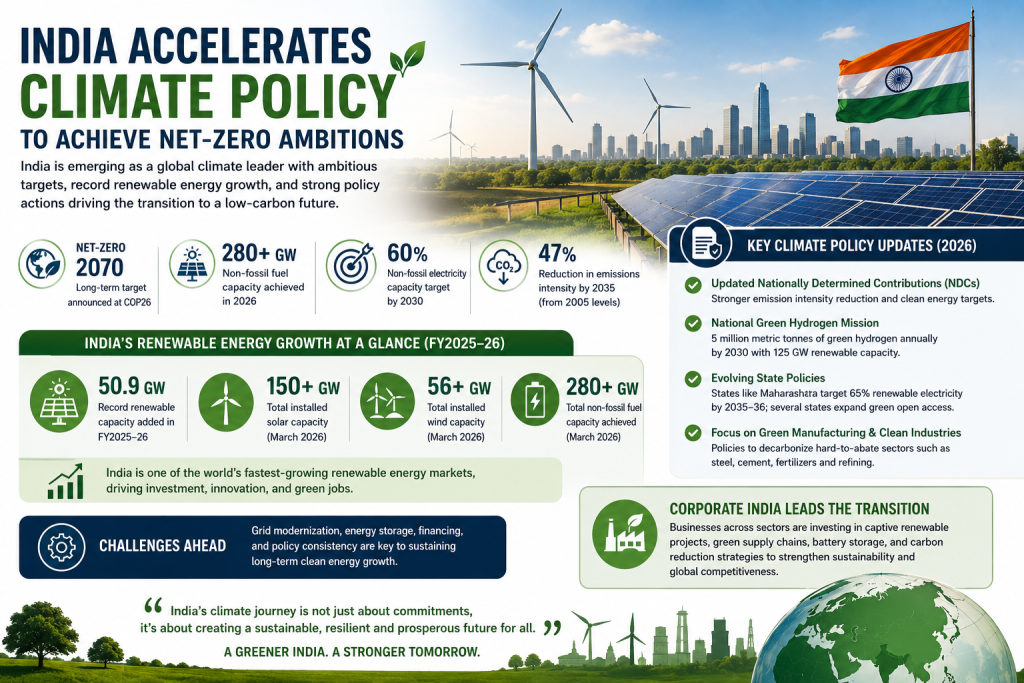
India is rapidly reshaping its climate and energy landscape as it pushes toward its long-term net-zero target of 2070. Over the last two years, the country has emerged as one of the fastest-growing renewable energy markets globally, combining ambitious policy reforms, record clean energy deployment, and industrial decarbonization initiatives to strengthen its position in the global climate transition.
The scale of India’s renewable energy expansion is unprecedented. According to recent government data, India’s total non-fossil fuel power capacity crossed 280 GW in 2026, with renewables accounting for more than half of the country’s installed electricity capacity ahead of its original Paris Agreement timeline. Solar energy continues to lead this transformation, with installed solar capacity surpassing 150 GW, while wind energy capacity has crossed 56 GW. India added a record 50.9 GW of renewable energy capacity in FY2025–26 alone, marking the highest annual clean energy addition in the country’s history.
At the policy level, India has significantly strengthened its climate commitments. In 2026, the government approved updated Nationally Determined Contributions (NDCs), targeting a 47% reduction in emissions intensity by 2035 compared to 2005 levels and aiming for 60% non-fossil electricity capacity within the next decade. These targets build upon earlier commitments announced at COP26, where India pledged to achieve 500 GW of non-fossil fuel capacity by 2030 and net-zero emissions by 2070.
The National Green Hydrogen Mission is also emerging as a central pillar of India’s decarbonization strategy. The policy aims to produce 5 million metric tonnes of green hydrogen annually by 2030, supported by nearly 125 GW of dedicated renewable energy capacity. Green hydrogen is expected to play a transformative role in hard-to-abate sectors such as steel, fertilizers, refining, and heavy transportation.
India’s energy transition is increasingly being driven not only by the central government but also by state-level initiatives. Maharashtra recently announced an ambitious renewable energy and storage policy targeting 65% renewable electricity by 2035–36, while several states are expanding green open-access frameworks to accelerate industrial renewable adoption. Gujarat, Rajasthan, Tamil Nadu, and Karnataka continue to emerge as renewable energy manufacturing and deployment hubs.
Corporate India is also playing a crucial role in this transition. Companies across automotive, steel, technology, and manufacturing sectors are investing heavily in captive renewable energy projects, green supply chains, battery storage, and carbon reduction strategies. Global technology firms and investors are increasingly partnering with Indian renewable developers to support low-carbon operations and sustainable manufacturing growth.
Despite the remarkable momentum, challenges remain. Grid modernization, battery storage deployment, financing, and policy consistency will be critical to sustaining long-term growth. Recent debates around stricter renewable energy grid regulations have highlighted the balancing act between maintaining grid stability and ensuring investor confidence in India’s clean energy sector.
Nevertheless, India’s climate trajectory signals a major transformation underway. The country is no longer viewed merely as a developing economy balancing growth and emissions—it is increasingly becoming a global clean energy powerhouse shaping the future of industrial sustainability, renewable integration, and climate innovation.
As the world intensifies efforts to limit climate change, India’s accelerated climate policies and renewable energy expansion demonstrate how economic growth and decarbonization can advance together. The coming decade will determine not only the country’s climate future, but also its global leadership in the emerging low-carbon economy.