
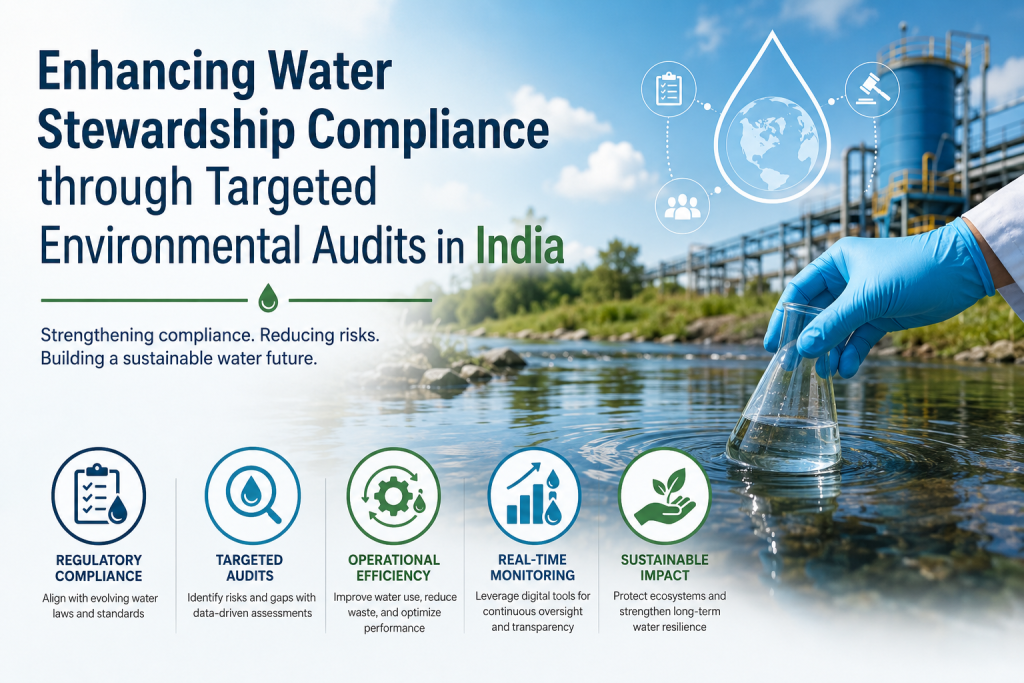
Enhancing Water Stewardship Compliance through Targeted Environmental Audits in India
The Compliance Clock (The Risk)
India’s regulatory environment is tightening its enforcement around environmental compliance audits, especially concerning water stewardship practices. Recent government directives emphasize rigorous monitoring and reporting requirements for industries on water usage, discharge standards, and waste-water treatment capabilities. Non-compliance risks include steep fines, operational shutdowns, and reputational damage — all within tightening timelines as state pollution control boards step up surveillance. Corporates are now mandated to not only submit detailed audit reports but also to demonstrate adherence to evolving water quality norms under the Water (Prevention and Control of Pollution) Act, 1974, and associated state-level amendments. Firms involved in manufacturing, agro-processing, and textiles — high water-intensive sectors — are in sharp focus, along with those operating near vulnerable hydrological zones.
This expanding compliance burden requires organizations to coordinate multi-layered audit protocols by predefined schedules, failing which could jeopardize statutory approvals and continuity in operations. The Indian environment regulatory landscape is shifting from periodic self-monitoring to comprehensive third-party audits, backed by digital reporting to pollution control authorities and public disclosures to stakeholders. The heightened regulatory clock is ticking for companies to proactively validate their water footprint and enforcement adherence to avoid penalties and ensure sustainable water governance.
The Operational Blindspot (The Friction)
Despite efforts to comply, many organizations face systemic challenges that render traditional compliance measures ineffective. Predominantly, legacy water compliance workflows rely heavily on fragmented data sources—manual meter readings, siloed environmental reports, and disconnected lab analyses—that complicate accurate audit readiness. These disjointed systems lack spatial intelligence capabilities, making it difficult to spatially correlate water usage with site-specific environmental impacts or regulatory catchment areas.
Moreover, current audit trails often lack real-time traceability and fail to provide end-to-end visibility across complex supply chains and multiple operational sites. This data opacity creates gaps in verifying compliance status, hampers early detection of violations, and increases the risk of human error during reporting. Compounding the issue, many compliance teams struggle with non-standardized documentation formats and delayed data consolidation, making it challenging to meet stringent submission deadlines or respond rapidly to regulatory inquiries.
The absence of integrated workflows also undermines companies’ ability to benchmark water performance metrics against evolving environmental standards or to identify strategic opportunities to reduce water dependency. This persistent friction not only risks penalties but also limits informed decision-making for water stewardship investments needed to achieve long-term sustainability goals.
The Strategic Intervention (The Solution)
Addressing these multifaceted challenges requires an integrated engineering and data-driven approach that unifies water compliance data, spatial intelligence, and operational controls into a seamless platform. By deploying advanced IoT-enabled water metering and automated data capture technologies, organizations can generate continuous, real-time water quality and usage datasets that feed directly into centralized compliance dashboards.
Coupling these measures with advanced geospatial analysis allows firms to map water consumption and discharge points against regulatory watershed and pollution sensitivity zones explicitly. This spatial insight enables proactive monitoring of site-specific compliance risks and tailored mitigation strategies aligned with local regulatory frameworks.
To further strengthen audit readiness, digital workflow orchestration standardizes documentation and automates compliance report generation, ensuring accuracy and timely submission. Integrated blockchain-based audit trails can be employed to guarantee data integrity, support transparent third-party verification, and provide regulators with tamper-proof evidence. Scenario modeling tools help leadership assess the impact of changing regulations on water use, enabling strategic investment decisions to optimize resource efficiency and reduce regulatory exposure.
Such a holistic compliance approach transforms water stewardship from a reactive obligation into a strategic business advantage — enhancing regulatory confidence, reducing operational risks, and positioning companies as sustainability leaders in India’s evolving environmental landscape.
Lgeom Greens Insight: Now is the critical time for Indian corporates to adopt sophisticated, integrated water compliance frameworks—partner with Lgeom Greens’ operational compliance desk to turn regulatory complexity into measurable sustainability value.
Source Intelligence: Read original documentation