
CARBON TAX AT THE GATE: WHAT INDIA’S ENGINEERING EXPORTERS MUST KNOW BEFORE THE EU EXPANDS CBAM
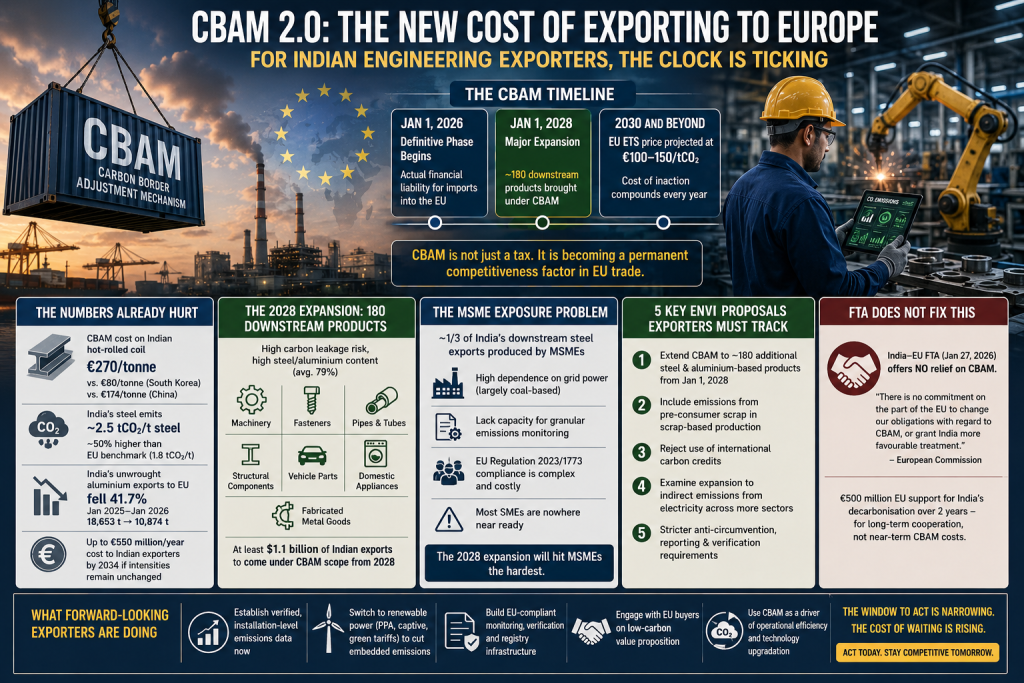
The EU’s Carbon Border Adjustment Mechanism entered its definitive phase on January 1, 2026. That date passed quietly for many Indian manufacturers, but the financial reality it unleashed is anything but quiet. And just as Indian exporters began calculating their first real liabilities, Brussels moved to expand the mechanism’s reach dramatically. The rules are changing again, and this time, the engineering sector is squarely in the crosshairs.
From Raw Materials to Factory Floors
Until now, CBAM applied to six core sectors: iron and steel, aluminium, cement, fertilisers, hydrogen, and electricity. That already captured a significant slice of Indian exports. A Chatham House study ranked India among the top eight most-affected countries globally, with base metals and articles making up roughly 9.6% of India’s total EU exports.
But the scope is set to broaden in ways that will hit Indian engineering exporters far harder. In a draft report issued on April 10, 2026, the European Parliament’s Committee on the Environment, Climate and Food Safety (ENVI) proposed five major changes to the CBAM regime, chief among them extending CBAM to around 180 additional steel- and aluminium-based manufactured products from January 1, 2028. These downstream goods items further along the value chain, were selected because they combine a high risk of carbon leakage with a high share of steel and/or aluminium in their composition, averaging 79% by content. The product list includes machinery, fasteners, pipes, tubes, structural components, vehicle parts, domestic appliances, and fabricated metal goods — in short, the core export portfolio of India’s engineering sector.
According to analysis of the Commission’s proposal, the downstream extension would bring at least $1.1 billion in Indian exports within CBAM’s scope from 2028.
The Numbers Already Hurt
Before discussing what’s coming, it’s worth understanding what the current phase already costs. The CBAM certificate price for Q1 2026 has been set at €75.36 per tonne of CO₂, calculated as the average of EU ETS auction clearing prices. Morgan Stanley analysts estimate CBAM charges on Indian hot-rolled coil at approximately €270 per tonne, significantly higher than the €80/tonne levied on South Korean steel and the €174/tonne on Chinese steel. That differential reflects India’s emission intensity problem.
India’s steel sector averages roughly 2.5 tonnes of CO₂ per tonne of steel produced nearly 50% greater than the EU benchmark of 1.8 tonnes. This gap is structural: approximately half of Indian production comes from coal-dependent facilities, and low-grade iron ore requires greater energy to process. The commercial consequence is stark. The Global Trade Research Initiative estimates that several Indian exporters may need to reduce metal prices by 15–22% so that EU buyers can absorb the carbon tax within their margins.
The aluminium picture is even more alarming. India’s unwrought aluminium exports to the EU dropped 41.7% between January 2025 and January 2026, from 18,653 tonnes to 10,874 tonnes a direct consequence of CBAM’s implementation. The mechanism could cost Indian exporters up to €550 million per year by 2034 if emission intensities remain unchanged.
The MSME Exposure Problem
The expansion to 180 downstream products introduces a new and particularly difficult challenge: it pulls small and medium enterprises into a compliance framework they are wholly unprepared for. About one-third of India’s downstream steel exports — the products, tubes, fasteners, and fabricated goods — are produced by MSME players, and they are set to be the worst-affected by the 2028 expansion. Unlike large integrated producers, MSMEs cannot easily invest in captive renewable energy or granular emissions monitoring. FISME Secretary General Anil Bhardwaj has noted that MSMEs rely heavily on grid power, which is largely produced through coal-based thermal plants, unlike large companies with captive generation capacity.
The compliance burden is not just financial — it is operational. The methodology required is EU Implementing Regulation 2023/1773-compliant granular data at the installation level, not just corporate sustainability reports. Most Indian SMEs in the engineering and auto-components belt are nowhere near ready.
Five ENVI Proposals That Exporters Must Track
Beyond the 180-product expansion, the ENVI committee’s April 2026 draft introduced four other significant changes. These include tightening carbon accounting rules for scrap-based production by including emissions from pre-consumer scrap; rejecting the use of international carbon credits for CBAM compliance; examining expansion of the mechanism to indirect emissions from electricity use across more sectors; and introducing stricter anti-circumvention, reporting, and verification requirements. The rejection of international carbon credits is particularly significant — it means Indian exporters cannot use offset mechanisms to reduce their CBAM liability. Actual emission reductions are the only path to lower costs.
The FTA Does Not Fix This
The India-EU Free Trade Agreement, concluded on January 27, 2026, has been greeted with considerable optimism in trade circles. But it offers no relief on CBAM. The European Commission’s chief spokesperson confirmed flatly: “There is no commitment on the part of the EU to change our obligations with regard to CBAM, or grant India more favourable treatment.” The FTA’s climate chapter does earmark €500 million in EU support for India’s decarbonisation efforts over two years, but this is structured around long-term green transition cooperation, not near-term CBAM compliance support.
What Forward-Looking Exporters Are Doing
The engineering exporters with the clearest sight lines are already treating CBAM as a product-competitiveness variable, not a compliance checkbox. Establishing verified, installation-level emissions data even before the 2028 deadline is the single highest-leverage action available. Switching to renewable power supply, whether through direct procurement, power purchase agreements, or green tariffs, directly reduces embedded emissions and therefore the CBAM certificate burden. Companies that can credibly demonstrate low-carbon intensity will be able to command premium positioning with EU buyers for whom carbon costs are increasingly part of procurement decisions.
EU ETS prices are projected to reach €100–150 per tonne by 2030 meaning the cost of inaction compounds with each passing year. The 2028 deadline is not far away, and the compliance infrastructure: emissions monitoring systems, third-party verifiers, registry accounts takes 12 to 18 months to build correctly. For Indian engineering exporters, the window to act is narrowing faster than the regulatory calendar suggests
References
- Bilancia Consulting. (2026, April 24). EU’s CBAM: What Indian exporters must do before the 2026 financial deadline. Bilancia Group. https://bilancia-group.com/eus-cbam-what-indian-exporters-must-do-before-the-2026-financial-deadline/
- Business Standard. (2026, April 16). EU’s proposed CBAM expansion may impact Indian exporters, says GTRI. https://www.business-standard.com/industry/news/eu-proposed-cbam-expansion-may-impact-indian-exporters-gtri-126041600732_1.html
- Business Today. (2026, April 20). Fresh export challenge for MSMEs: EU plans to expand carbon tax to 180 more steel, aluminium products. https://www.businesstoday.in/industry/story/fresh-export-challenge-for-msmes-eu-plans-to-expand-carbon-tax-to-180-more-steel-aluminium-products-526508-2026-04-20
- Carbon Pulse. (2025, July 16). Indian exporters face €550 mln carbon liability as EU’s CBAM takes full effect in 2026. https://carbon-pulse.com/418293/
- EnCarbonSys. (2026, February 23). CBAM 2026 for Indian exporters: Complete compliance guide for steel, aluminum & cement. https://encarbonsys.com/cbam-blog/cbam-india-exporters-guide-2026.html
- Eurometal. (2026, April 8). European Commission provides critical CBAM cost component. https://eurometal.net/european-commission-provides-critical-cbam-cost-component/
- Gump, A. (2025, December 22). EU Carbon Border Adjustment Mechanism: Financial obligations commence amid proposed scope expansion to include new downstream products. Akin Gump Strauss Hauer & Feld LLP. https://www.akingump.com/en/insights/alerts/eu-carbon-border-adjustment-mechanism-financial-obligations-commence-amid-proposed-scope-expansion-to-include-new-downstream-products
- MarketScreener. (n.d.). EU aluminium and cement imports to face higher emissions costs, draft shows [citing Morgan Stanley analysts]. https://uk.marketscreener.com/news/eu-aluminium-and-cement-imports-to-face-higher-emissions-costs-draft-shows-ce7d50d8d88cff21
- Osmosis Investment Management. (2025, December 18). The EU’s Carbon Border Adjustment Mechanism (CBAM). https://www.osmosisim.com/the-eus-carbon-border-adjustment-mechanism-cbam/
- Outlook Business. (2026, April 16). How CBAM expansion is adding new challenges for India despite the FTA. https://www.outlookbusiness.com/economy-and-policy/how-eus-cbam-expansion-is-adding-new-challenges-for-india-despite-the-fta
- Renewable Watch. (2026, February 20). Impact of Europe’s CBAM on Indian exporters: Report. https://renewablewatch.in/2026/02/20/impact-of-europes-cbam-on-indian-exporters-report/
- Sprih. (2026, January 28). India-EU Free Trade Deal CBAM impact explained. https://www.sprih.com/blogs/india-eu-free-trade-deal-cbam-impact/
- TIC Council / Alcircle. (2026, May). CBAM hits Indian aluminium export by 41%: Indian Carbon Credit Trading Scheme to reverse the slide. https://www.alcircle.com/news/cbam-hits-indian-aluminium-export-by-41-indian-carbon-credit-trading-scheme-to-reverse-the-slide-118416
- Trade Compliance Resource Hub. (2025, December 19). Commission proposes expansion of EU CBAM to downstream goods and addresses potential CBAM abusive practices. https://www.tradecomplianceresourcehub.com/2025/12/19/commission-proposes-expansion-of-eu-cbam-to-downstream-goods-and-addresses-potential-cbam-abusive-practices/