
Harnessing Green Hydrogen: Navigating Demand Growth and Integration Challenges
India is at an inflection point. With fossil fuel import bills straining the current account and climate commitments growing louder by the quarter, the country has placed an audacious bet on a molecule most people have never heard of: green hydrogen. The National Green Hydrogen Mission (NGHM), approved in January 2023 with an outlay of ₹19,744 crore, is no longer just a policy document it is a live industrial programme, and 2025 turned out to be the year it started showing its teeth.
The Numbers Tell a Big Story
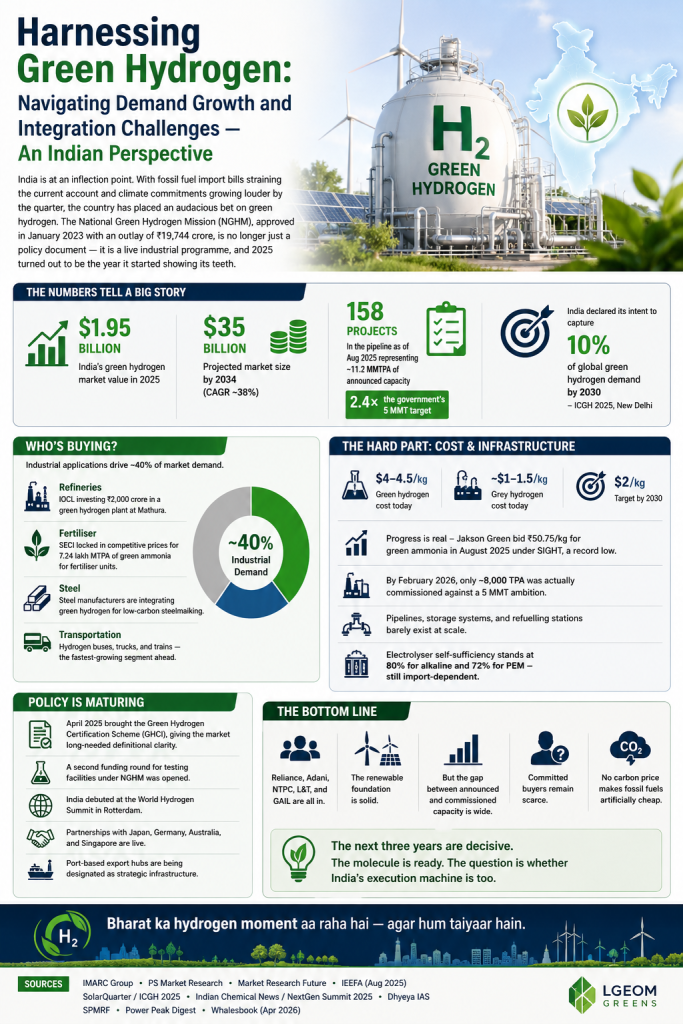
India’s green hydrogen market was valued at $1.95 billion in 2025 and is projected to reach $35 billion by 2034, growing at a CAGR of nearly 38%. What’s driving this? A combustible mix of falling renewable energy costs, industrial decarbonisation pressure, and serious government money following serious government talk.
As of August 2025, 158 green hydrogen projects were at various stages of development, representing an announced capacity of approximately 11.2 MMTPA nearly 2.4 times the government’s own 5 MMT target for 2030. That gap between ambition and execution is both inspiring and sobering.
At the 3rd International Conference on Green Hydrogen (ICGH 2025) in New Delhi, India declared its intent to capture 10% of global green hydrogen demand by 2030 a statement of intent that has the world paying attention.
Who’s Buying? Sectors Driving Demand
The industrial sector holds the largest share approximately 40% in 2025 driven by substantial hydrogen demand from refineries, fertiliser plants, and steel manufacturers. Indian Oil Corporation is developing green hydrogen plants at its refineries, including the Mathura facility with an investment of approximately ₹2,000 crore.
Steel is the next frontier. India is the world’s second-largest steel producer, and its blast furnaces are carbon-intensive by design. Hydrogen-based Direct Reduced Iron (DRI) technology is being piloted at major facilities a shift that could reshape the sector’s emissions profile entirely. The transportation segment is expected to register the fastest growth, supported by government pilot programmes for hydrogen-powered buses, trucks, and trains.
SECI has already discovered globally competitive prices for 7.24 lakh MTPA of green ammonia supply to fertiliser units, and projects have been sanctioned for 20,000 MTPA of green hydrogen to be supplied to IOCL, BPCL, and HPCL refineries.
The Hard Part: Cost and Infrastructure
Here’s where the narrative gets complicated. Green hydrogen currently costs about $4–4.5/kg — significantly higher than grey hydrogen and the absence of a carbon pricing mechanism makes fossil fuels artificially cheap competitors.
A major milestone was achieved in August 2025 when Jakson Green recorded a price of approximately ₹50.75/kg for green ammonia under the SIGHT scheme, with even lower bids of ~₹49.80/kg reported by SECI signs that the economics are beginning to move. The target is a Levelised Cost of Hydrogen (LCOH) of around $2/kg by 2030, but that requires everything to go right.
By February 2026, only about 8,000 tonnes per annum (TPA) were commissioned against the 5 MMT target a significant gap in implementation. Specialised pipelines, hydrogen-grade storage systems, and refuelling stations barely exist at scale. India’s reliance on imported technology and components, especially for electrolysers, remains a major hurdle the potential for domestic production is estimated at 80% for alkaline electrolysers and 72% for PEM electrolysers, showing more work is needed.
Policy Is Maturing — Fast
2025 has been pivotal in establishing the operational, financial, and regulatory architecture necessary to transform the NGHM from a statement of intent into a tangible industrial reality. In April 2025, the Ministry of New and Renewable Energy launched the Green Hydrogen Certification Scheme (GHCI), bringing clarity and credibility to the market.
The primary barriers lack of committed buyers, high production costs, varying definitions of green hydrogen, and inadequate infrastructure for storage and transportation are now being addressed through targeted policy interventions. India has also signed hydrogen partnerships with Japan, Germany, Australia, and Singapore, with port-based export hubs being designated as strategic infrastructure.
The Honest Assessment
India has the solar irradiance, the industrial demand, the political will, and increasingly the capital to become a genuine green hydrogen superpower. Reliance, Adani, NTPC, L&T, and GAIL are all in. The renewable foundation is solid. But the gap between announced projects and commissioned capacity is uncomfortably large.
The next three years are decisive. If India can bring even 10–15% of its announced capacity online, close the cost gap to $2/kg through scale and indigenisation, and build anchor infrastructure in its first hydrogen hubs, the claim to global leadership will be earned. If projects stall in financing queues and regulatory delays, the world’s most ambitious hydrogen programme risks becoming a cautionary tale.
The molecule is ready. The question is whether India’s execution machine is too.
Source:
IMARC Group · PS Market Research · Market Research Future · IEEFA (Aug 2025) · SolarQuarter / ICGH 2025 · Indian Chemical News / NextGen Summit 2025 · Dhyeya IAS · SPMRF · Power Peak Digest · Whalesbook (Apr 2026)