
Transforming Agricultural Residue Management: Unlocking Renewable Energy Potential in India’s Rural Heartland
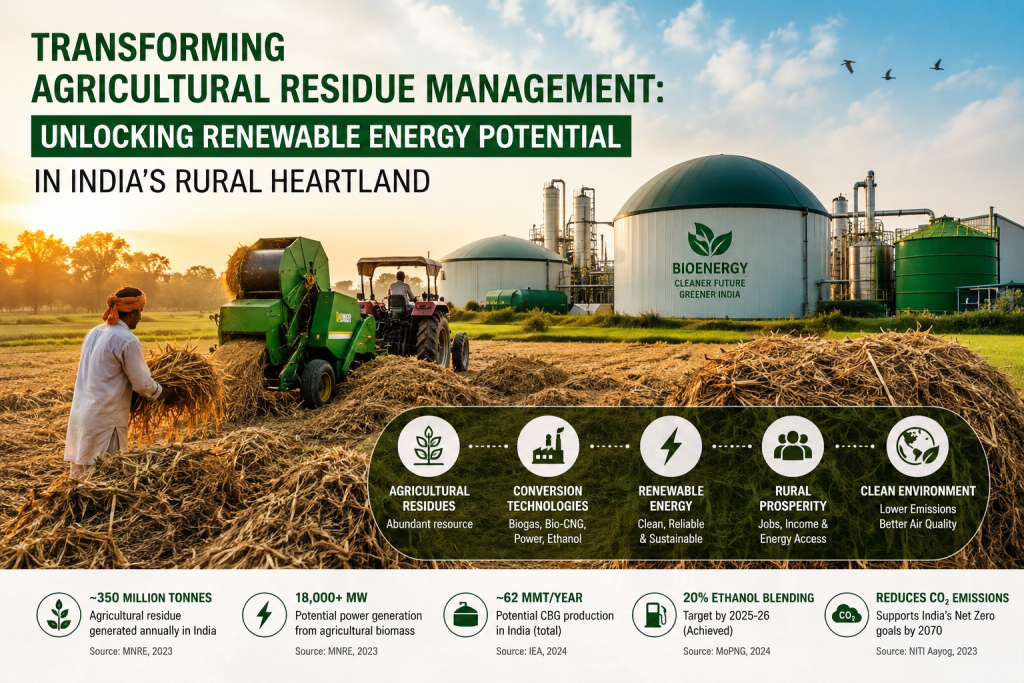
Every winter, North India faces a familiar crisis. Thick smog engulfs cities, air quality plummets, and attention turns toward stubble burning in Punjab and Haryana. But hidden within this environmental challenge lies a powerful opportunity, transforming agricultural residue into a driver of India’s renewable energy transition.
India generates nearly 350 million tonnes of agricultural residue annually, including paddy straw, sugarcane bagasse, wheat straw, and husk. A significant portion of this biomass is either burned in fields or left unused, despite its immense energy potential. According to the Ministry of New and Renewable Energy (MNRE), agricultural biomass could support over 18,000 MW of renewable power generation in India.
The question is no longer whether agricultural waste has value. The real challenge is how efficiently India can convert this untapped resource into clean energy and rural economic growth.
From Farm Waste to Fuel
For decades, crop residue was viewed largely as a disposal problem. Farmers, under pressure to prepare fields quickly for the next sowing cycle, often resorted to open burning as the fastest and cheapest option. While this practice contributes heavily to seasonal air pollution and greenhouse gas emissions, the narrative is beginning to change.
Agricultural residues are now increasingly being used for:
-
Biomass-based power generation
-
Compressed biogas (CBG)
-
Bioethanol production
-
Industrial fuel substitution
-
Biochar and organic fertilizer production
This shift reflects the rise of a circular bioeconomy where agricultural waste becomes an economic asset rather than an environmental burden.
India’s Bioenergy Opportunity
India’s growing energy demand and dependence on imported fossil fuels make bioenergy strategically important. Unlike solar and wind, biomass offers stable and dispatchable energy while simultaneously supporting rural livelihoods.
Government initiatives such as the SATAT scheme, Gobardhan programme, and the National Bioenergy Programme are accelerating investments in compressed biogas and waste-to-energy infrastructure. India’s ethanol blending targets have also expanded demand for biomass feedstocks.
Recent studies estimate that India has the potential to produce nearly 62 million metric tonnes of compressed biogas annually, with agricultural residues contributing a substantial share. This presents a major opportunity for reducing fossil fuel dependence while creating decentralized energy systems.
Rural India at the Centre of the Transition
What makes agricultural residue management unique is its direct connection to rural development. A strong biomass ecosystem can generate additional farmer income, create local jobs in biomass collection and logistics, and strengthen village-level energy infrastructure.
Punjab alone generates around 20 million tonnes of paddy straw every year. Increasingly, this biomass is being redirected toward bioenergy plants, pellet manufacturing units, and industrial applications instead of being burned in fields.
For farmers, this transition can create a new revenue stream from materials that previously had little economic value.
Technology Is Changing the Game
Advances in biomass conversion technologies are making residue utilization more commercially viable than ever before. Modern gasification systems, anaerobic digestion plants, and biomass densification technologies are improving efficiency and reducing operational costs.
At the same time, digital technologies such as AI-based biomass mapping, satellite monitoring, and IoT-enabled supply chain systems are helping optimize residue collection and transportation networks.
India is also witnessing increasing private-sector participation in bioenergy and compressed biogas infrastructure, signalling growing confidence in the sector’s long-term potential.
Challenges That Still Need Attention
Despite the progress, major barriers remain. Biomass supply chains are fragmented, transportation costs are high, and storage infrastructure is often inadequate. Seasonal availability of crop residue also affects operational continuity for bioenergy facilities.
Policy coordination remains another challenge. Agricultural residue management cuts across agriculture, renewable energy, climate policy, and rural development, requiring integrated planning and long-term investment support.
Without strong institutional coordination, many projects struggle to scale sustainably.
The Road Ahead
India’s renewable energy future cannot rely solely on solar and wind power. Agricultural biomass offers something equally important — a pathway that combines clean energy generation with rural development, waste management, and climate action.
The future of residue management lies in building integrated rural bioenergy ecosystems where agricultural waste powers industries, transport systems, cooking fuel networks, and decentralized electricity generation.
What is currently burned in fields could become one of India’s strongest tools for achieving energy security and sustainable growth.
For India’s rural heartland, the clean-energy revolution may already be growing in its fields.
Sources
- Ministry of New and Renewable Energy (MNRE), Government of India
- International Energy Agency (IEA) – India Bioenergy Market Reports
- NITI Aayog – Bioenergy and Waste-to-Wealth Reports
- SATAT Initiative, Ministry of Petroleum & Natural Gas
- Central Pollution Control Board (CPCB) – Crop Residue Burning Reports
- Indian Agricultural Research Institute (IARI) – Crop Residue Management Studies
- Global Bioenergy Statistics 2025
- Renewable and Sustainable Energy Reviews (Elsevier)
- Biomass and Bioenergy Journal (ScienceDirect)