
Unlocking $100 Billion in Industrial Decarbonization Opportunities in India: Strategic Imperatives for Corporate Leaders
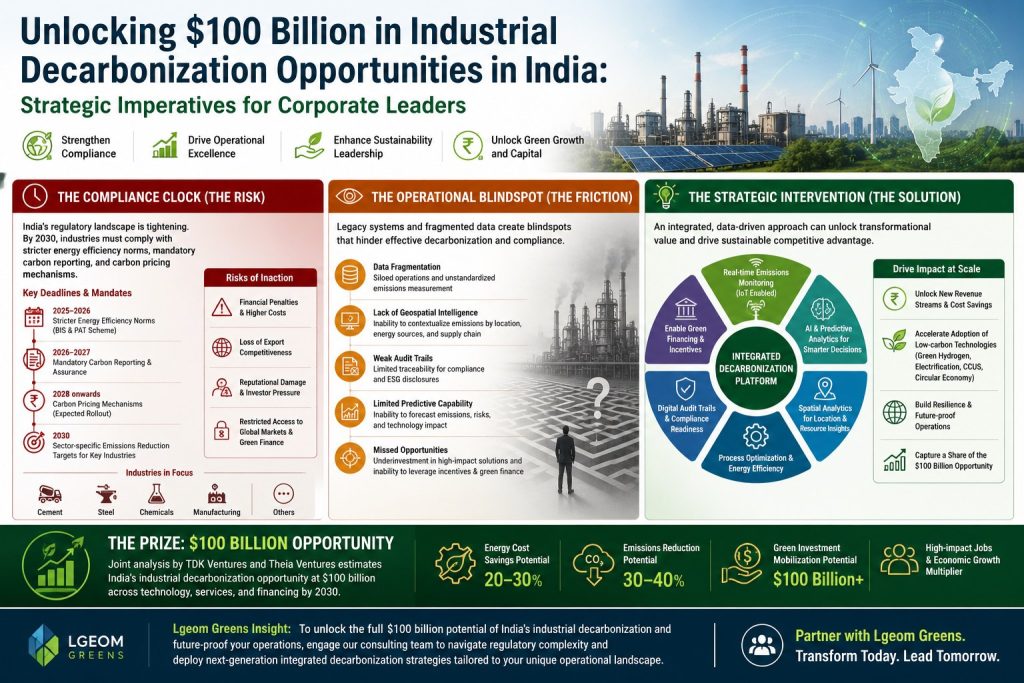
The Compliance Clock (The Risk)
India’s ambitious industrial decarbonization agenda is rapidly evolving, driven by national commitments to reduce greenhouse gas emissions under the country’s updated Nationally Determined Contributions (NDCs) aligned with the Paris Agreement. Regulatory frameworks are tightening with sector-specific emissions reduction mandates targeting heavy industries such as cement, steel, and chemicals by 2030. Key deadlines include compliance with stricter energy efficiency norms, mandatory carbon reporting, and anticipated carbon pricing mechanisms designed to penalize high-emission operations. Failure to adapt to these mandates risks significant financial penalties, loss of export competitiveness amid green trade conditionalities, and reputational damage in increasingly sustainability-conscious markets.
The Operational Blindspot (The Friction)
Traditional approaches based on basic emissions tracking or carbon accounting software lack the sophistication required for complex industrial ecosystem decarbonization. Data fragmentation is rampant, with disparate operational silos and unstandardized emissions measurement protocols undermining reliable analytics. Many legacy systems lack geospatial intelligence capabilities needed to contextualize emissions relative to plant location, energy sources, and supply chain interdependencies. Additionally, audit trails for decarbonization validation are weak or absent, complicating regulatory compliance verification and corporate ESG disclosures. This disconnect results in suboptimal decision-making, underinvestment in high-impact technologies, and missed opportunities to capitalize on government incentives or emerging green financing options.
The Strategic Intervention (The Solution)
Industrial decarbonization presents a transformational opportunity—estimated at $100 billion according to recent joint analysis by TDK Ventures and Theia Ventures—to create competitive advantage and drive sustainable growth for Indian manufacturers. Achieving this requires an integrated engineering and data-driven approach that combines real-time emissions monitoring, advanced process optimization, and predictive analytics powered by AI and IoT technologies. Incorporating spatial analytics enables firms to dynamically assess energy sourcing, process efficiencies, and carbon sequestration options specific to their operational geography. Robust digital audit trails ensure transparent compliance and facilitate access to green financing. Furthermore, integrating these capabilities into a cohesive platform empowers decision-makers with actionable insights to prioritize investments in low-carbon technologies such as green hydrogen, circular economy practices, and electrification of industrial heat.
Lgeom Greens Insight: To unlock the full $100 billion potential of India’s industrial decarbonization and future-proof your operations, engage our consulting team to navigate regulatory complexity and deploy next-generation integrated decarbonization strategies tailored to your unique operational landscape.